Soften Oy, based in Turku, is an expert in acoustic interior solutions. With products that achieve the highest acoustic classifications we create spaces with improved sound environments—making them more comfortable and enjoyable to use. But how does acoustics affect different spaces, and how can it be improved?
The sound environment of a space has a significant impact on people’s comfort and well-being. Echoing spaces and disturbing noise can have several negative effects. However, acoustics can be improved and managed, making it well worth the attention. Good acoustics are essential in both public spaces and homes.

01
Reverberation time
In acoustics, reverberation time is often discussed—it refers to how long sound continues to be heard after the source has stopped. When a sound source is turned off, the sound remains audible for a short time due to sound waves reflecting off the surfaces of the space. The duration for which the sound can still be heard after the source has fallen silent defines the reverberation time.When reverberation time is too long, speech sounds begin to overlap and become unclear. As a result, people tend to raise their voices or increase the volume of devices such as televisions, which leads to an even noisier sound environment.

02
Sound absorption
The size and shape of a space, along with the amount and placement of sound-absorbing materials, have a decisive impact on reverberation time. As wall surface area increases, reverberation time also increases unless there are sufficient sound-absorbing surfaces in the space. By adding sound-absorbing materials and positioning them effectively, the acoustics of a space can be improved and reverberation time reduced.
Hard, sound-reflective surfaces absorb very little sound. For this reason, acoustic treatment should be implemented in a balanced way—so that sound-absorbing surfaces are placed opposite hard surfaces.

03
Sound absorption classifications
Sound absorption classes are defined as A, B, C, D and E according to the EN ISO 11654 standard. Absorption performance is measured across frequencies ranging from 200 to 5000 Hz. Products classified in absorption class A offer the highest level of sound absorption, while those in class E provide the lowest.
Soften’s interior panels equipped with acoustic filling belong to the highest possible sound absorption class A (EN ISO 11654).
Acoustics have a significant impact on both mental and physical well-being. The effects of noise on public health have been found to be the second most significant after fine particulate matter.
A noisy and chaotic environment makes normal communication difficult. It causes fatigue and stress, and places a strain on memory, thinking, and emotional processing. The effects of noise can include sleep disturbances, reduced concentration and learning ability, as well as disorders of the cardiovascular system. In severe cases, noise can lead to hearing loss and permanent damage.

A noisy environment causes stress for both children and staff. Teaching situations rely largely on verbal communication—speaking and listening—which are supported by good acoustics. Speech audibility and clarity are especially important in daycares, where children are still developing their language skills. While adults can often understand words or sentences from just a few syllables, children do not yet have this ability. For this reason, a well-designed sound environment plays a particularly important role.
Poor acoustic conditions also have a direct impact on the well-being of teaching staff. Reduced speech clarity leads to vocal strain—voices tire more easily, and prolonged strain can even result in vocal cord issues. Noise also increases general fatigue and stress.
A comfortable and calm learning environment has been shown to encourage more relaxed behaviour and voice use, bringing a sense of calm to schoolwork. Unusual sounds are easier to distinguish, which also improves overall safety.
Acoustics are an important part of ergonomics. Noise is the most common indoor environmental issue in offices—especially distinct, distracting speech. For this reason, particular attention should be paid to acoustics in workplaces and office environments, as it has a significant impact on employees’ mental and physical well-being. Good acoustics make communication easier and help people concentrate on their tasks, while also improving performance and efficiency, reducing stress, and enhancing overall comfort.
Popular open-plan offices and flexible workspaces present specific acoustic challenges. Employees are often disturbed by background noise, external sounds, and especially by other people’s speech and its clarity. Good room acoustics in open-plan offices are achieved when speech intelligibility between workstations is kept low.
Noise levels can be reduced by adding sound-absorbing materials to a space and placing them in the right locations. As noise levels decrease, people no longer feel the need to raise their voices and begin to speak more quietly without even noticing. As a result, background noise is further reduced and the overall acoustics of the workspace improve.
Acoustics should be considered as a whole. The final acoustic result is influenced by factors such as the amount of sound-absorbing material, high partitions between workstations, and suspended elements. A pleasant masking sound that effectively covers speech can also complement the overall solution.
It is estimated that around 10% of the working-age population has some form of hearing impairment. Special attention should therefore be given to the working conditions of employees who use hearing aids. Hearing aids amplify all surrounding sounds, including background noise, which can make it difficult to follow speech. In such cases, the importance of acoustics becomes even more critical in workplace design.


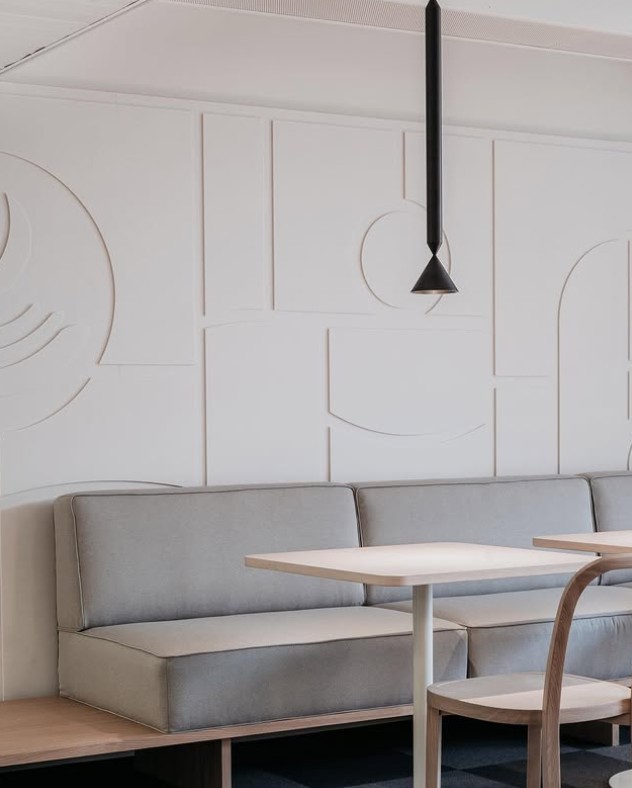

In recent years, more attention has been given to improving the acoustic conditions of residential environments. Modern home design often favors high ceilings, large window surfaces, and hard wall and floor materials, which can increase echo-related issues. The current trend of minimal use of soft furnishing materials is often not sufficient to absorb sound, making the reverberation in living spaces more noticeable. Open-plan layouts can also present challenges for acoustics.
Acoustic design can also support different activities at home. Spaces such as home theaters, listening rooms, or areas for playing instruments all benefit from good acoustics to create a pleasant sound environment. Stairwells are another effective area for acoustic treatment in many houses, helping to reduce the transfer of sound between different floors.
At home, it is important to consider the individual needs of the occupants, as well as overall comfort and interior aesthetics. Acoustics should ideally be taken into account already at the architectural design stage, allowing for a more holistic, cost-effective, and functional solution than addressing issues afterwards.
Soften Oy’s acoustic products are available through our project sales team and our network of resellers. We deliver quickly throughout Finland.
.svg)


.png)


.svg)